Service Charge Accounts Explained: What Every Director Must Get Right
A plain-English guide to service charge accounts for self-managing RTM directors. What the law requires, how the money is held on trust, and the mistakes to avoid.

Service charge accounts are the yearly record of the money you collect from leaseholders and what you spend it on. For a self-managing block, the law treats that money as held on trust, not your RTM company income, and sets strict rules for how it must be accounted for. Getting it wrong is one of the most common reasons directors end up in front of a tribunal.
This article is general information, not legal or financial advice. Always take qualified professional advice for your own building.
If you took over your block through Right to Manage, nobody handed you a manual. You won the fight to take control, and now the accounts have landed on your desk, with no predecessor to ask and no finance training to fall back on. This is the part most directors worry about. Here is what actually matters.
What Are Service Charge Accounts?
Your service charge accounts are the financial statement for the building's year. They show three things:
- What came in. The service charge you demanded from each leaseholder, including the reserve fund.
- What went out. Repairs, insurance, cleaning, the agent if you have one, and everything else, including major maintenance using reserve funds.
- What is left. The balance carried forward, including any reserve funds.
The service charge accounts are not the same as your company accounts filed at Companies House. Those are two separate documents, under different law, with different deadlines, a point we will come back to in the FAQs below, because mixing them up is a classic trap.
Why Is Service Charge Money Treated Differently From RTM Company Money?
This is the single most important thing to understand. The service charge money you collect is not yours, and it is not the RTM company's either.
Service charge money is held on trust for the leaseholders as a group. Legally, you are looking after their money. You can only spend it on the building, in line with the lease, and you must keep it separate from any other funds. This trust duty sits in the Landlord and Tenant Act 1987 (section 42).
In plain terms, it is the residents' money, in your safekeeping. Treat it as anything else and you are in breach, even if every penny was spent sensibly.

What Has to Be in the Accounts?
A proper set of service charge accounts will show:
- Total service charge income for the year.
- All expenditure, itemised clearly enough that a leaseholder can understand it.
- The admin (day-to-day) fund and the reserve fund reported separately, each with its own opening and closing balance.
- Any arrears.
Showing the two funds separately in the accounts matters even if you hold them in one bank account. A leaseholder should be able to see what was spent running the building this year, and what is being set aside for the big jobs to come.
Do the Accounts Need to Be Audited or Certified?
It depends on your lease. Most leases require the accounts to be independently examined or certified by a qualified accountant each year. That is a separate step from preparing them.
Here is something most directors do not know. Service charge accounts are not ordinary accounts. They have to follow a specialist accounting standard called ICAEW TECH 03/11. This standard was written specifically for money that is held on trust, like your service charges.
Most high street accountants do not specialise in this and do not prepare accounts to that standard. So if you hand your service charge accounts to the same accountant who does the books for the local shop, you can end up with something that looks right but does not actually meet the standard.
This is also true when finding an accountant to audit or certify accounts you may have prepared yourself, if required by your lease.
Can You Do the Accounts Yourself?

In most cases, yes, at least the bulk of the work. Most leases only require a qualified accountant to certify the final accounts, not to keep the day-to-day records.
So you can prepare the figures yourself, or use software built specifically for service charge accounts to prepare them for you, and then hand a clean, finished set to an accountant to certify. That keeps the accountant's job small and the bill low. Always check your own lease, because a small number do require an accountant to prepare the accounts as well as certify them.
When Do the Accounts Have to Be Sent Out?
You need to issue the accounts to every leaseholder within six months of the service charge year end. Send them alongside the AGM notice and the next year's budget, so it is one clear communication rather than three.
Also, any leaseholder has the right to formally request a summary of costs. If you do not provide it, they can lawfully withhold their service charge until you do (Landlord and Tenant Act 1985, sections 21 and 21A). So late or missing accounts do not just look bad. They can switch off the income you need to manage the building.
What Happens If You Get the Accounts Wrong?
This is the part that keeps directors up at night, so let me be straight about where you actually stand. Most of the risk is not a fine landing on your doormat. It is quieter than that, and in some ways more serious.
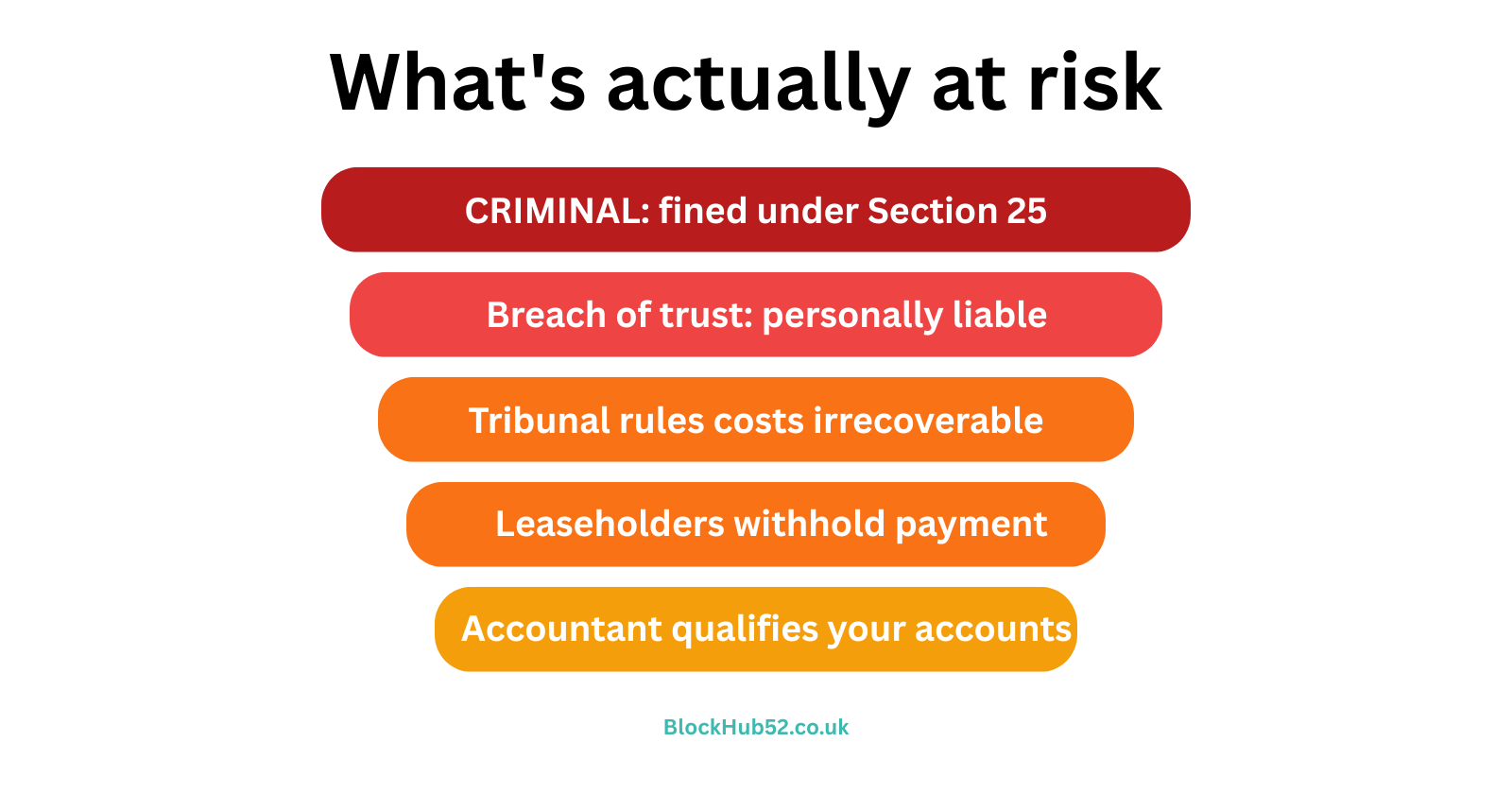
- Leaseholders can challenge the charges, and win. Any leaseholder can take the service charge to the First-tier Tribunal (FTT) and argue it was unreasonable or not properly demanded. If the tribunal agrees, it can rule that some or all of the cost cannot be recovered from the leaseholders. That money does not disappear. It falls back on the company, and if the company cannot cover it, on the directors.
- Leaseholders can lawfully stop paying. If you have not met your obligations, for example you have not issued proper accounts or supplied a summary when asked, a leaseholder can withhold their service charge until you put it right. A building that stops collecting its income gets into trouble fast.
- There is one point where you can actually be fined. If a leaseholder formally asks for the summary of costs, or to inspect the documents behind it, and you fail to provide it without a good reason, that is a criminal offence under section 25 of the Landlord and Tenant Act 1985. The company can be fined. This is the one part of service charge accounting where getting it wrong is a criminal matter, not just a civil one.
- Misusing the trust money is a breach of trust. Because the service charge is held on trust, spending it on the wrong thing, or mixing it up, is a breach even if every penny was well meant and nothing was actually lost. A breach of trust can make a director personally liable to repay the loss from their own pocket.
- Your accountant can flag the accounts. If the accounts are not right, a qualified accountant will not sign them off cleanly. They add a formal warning, called a qualification. That qualification tells every leaseholder the building's money is not being run properly, and it makes raising funds for a big future repair much harder, because people do not want to pay into a pot they do not trust.
None of this requires you to have been dishonest. Almost every problem comes from a good person doing their best with no training and no handover. That is the point. Getting the process right is not about being clever. It is about being correct, and being able to show that you were correct if anyone ever asks.
Getting the accounts right is not about being clever. It is about being correct, and being able to show it if anyone ever asks.
The Mistakes Directors Make Most Often
These come up again and again. None of them are dramatic. They are the small, ordinary slips a busy volunteer makes, and every one of them is avoidable.
- Paying the wrong thing out of the trust money. The service charge can only pay for running the building, and only for costs the lease actually allows you to recover. Some costs are not recoverable through the service charge at all. Pay one of those out of the trust money and you have spent the leaseholders' money on something they cannot lawfully be charged for. Before you pay any bill, ask one question: does the lease let me charge this to the service charge?
- Treating the two funds as one pot. Even where you hold the money in a single account, the admin fund and the reserve fund are different money doing different jobs. The admin fund pays this year's running costs. The reserve fund is being saved for the big jobs years away, like the roof or the lift. If the accounts lump the two together, nobody, including you, can see whether the building is actually saving enough. Keep the admin fund and the reserve fund clearly separate in the figures, every year. Having two bank accounts is an easy solution.
- Leaving the accounts too late. The accounts have to reach leaseholders within six months of the year end, but the real mistake is letting the records pile up until then. If you only look at the money once a year, errors have months to hide and arrears have months to grow. A short monthly check, even fifteen minutes, stops the year end from becoming a scramble. Doing a monthly bank reconciliation will also bring errors to light immediately. It is so much easier to remember what a payment was for in the past month than 12 months ago.
- Using the wrong accountant. A high street accountant who is excellent with small business books may never have prepared a set of residential service charge accounts. The trust rules and the TECH 03/11 standard are a specialisation. The wrong accountant often costs more in the end, because the accounts come back not quite right and have to be redone. Ask any accountant directly whether they do residential service charge accounts before you appoint them.
- No proper paper trail. This is the quiet one that catches people out. Receipts in a kitchen drawer, the budget on one person's laptop, the bank login in their head. It works right up until that person is ill, moves away, or simply steps down, and then the whole building is stuck. A clear, shared record of every demand, payment and invoice is not just good accounting. It is what lets the next director take over without starting from nothing.
Every one of these is avoidable. None of them needs an accountant's brain. They need a bit of structure, kept up a little at a time, so the accounts are simply right by the time the year ends.
Frequently Asked Questions
Are service charge accounts the same as company accounts?
No, and this catches a lot of directors out. Your RTM company wears two hats, so it produces two completely different sets of accounts:
Does service charge money belong to the company?
No. It is held on trust for the leaseholders under the Landlord and Tenant Act 1987, section 42. Directors look after it on the leaseholders' behalf, must keep it separate from anything else, and can only spend it on the building in line with the lease.
Do I have to keep the reserve fund in a separate bank account?
Not as a matter of law. A single designated trust account for the whole building satisfies section 42. However, best practice from the ICAEW, The Property Institute and RICS is to hold the admin fund and the reserve fund in two separate accounts, and that is the standard accountants and tribunals expect to see.
Do service charge accounts have to be certified by an accountant?
Usually yes. Most leases require independent certification or examination by a qualified accountant each year, separate from preparing the accounts. Residential service charge accounts follow the specialist ICAEW TECH 03/11 standard, which many general accountants do not apply.
What happens if I send the accounts out late?
Leaseholders can formally request a summary of costs and, if it is not provided, can lawfully withhold their service charge until it is. Late accounts also increase the risk of a challenge at the First-tier Tribunal.
Where to Start
If you have recently taken over your block, two free resources will help you get the basics in place straight away:
- Free UK Block Compliance Wall Chart. Every key statutory deadline on one page, including your accounts and AGM.
- Try BlockHub52 free for 45 days. Service charge tracking and compliance built for self-managing RTM and RMC directors, so the accounts, the funds and the audit trail are kept right automatically, and so the next director inherits a working system rather than a shoebox of receipts.
Related Reading
BlockHub52 provides general information only. Nothing in this article is legal or financial advice. Always take independent qualified advice for your own situation.